What Is a Mortgage Recast and When Does It Make More Sense Than Refinancing?
By Terry Leinneweber · June 27, 2026
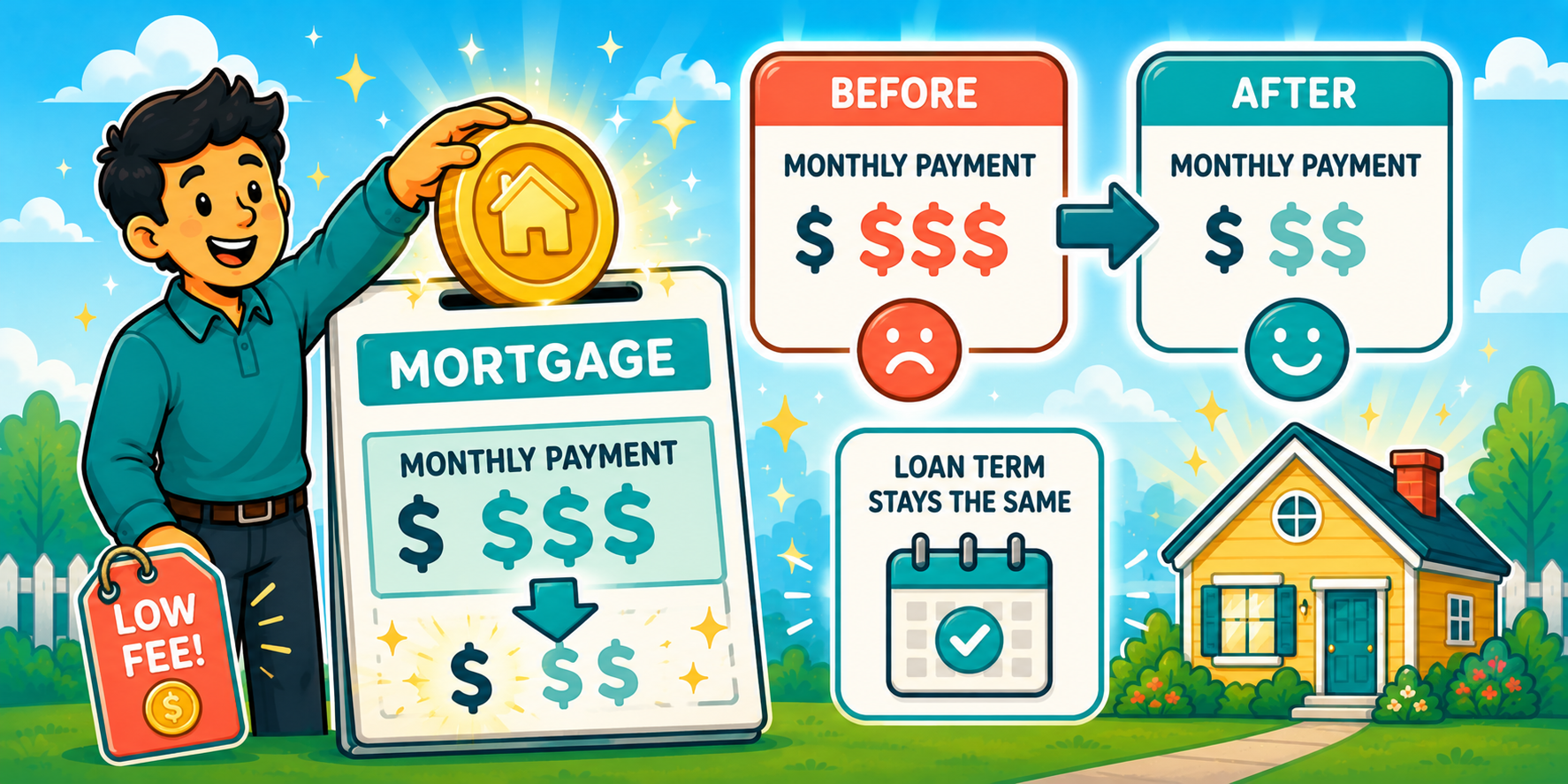
A mortgage recast lowers your monthly payment without a new loan or credit check. Here's how it works, what it costs, and who it's right for.
What Is a Mortgage Recast and When Does It Make More Sense Than Refinancing?
You've come into a lump sum. Maybe you sold a previous home. Maybe you received an inheritance, a bonus, or proceeds from a business sale. You're sitting on cash and your instinct is to put it toward your mortgage.
The obvious move is to refinance. But if your existing rate is already competitive, refinancing means paying thousands in closing costs, going through full underwriting again, and potentially trading a good rate for a market rate that isn't better.
There's a less-known alternative that accomplishes something refinancing can't: a mortgage recast. It permanently lowers your monthly payment using a lump sum payment without replacing your loan, changing your rate, or requiring a credit check.
Most buyers have never heard of it. Here's exactly how it works.
What a Mortgage Recast Is
A mortgage recast, also called re-amortization, is the process of making a large lump sum payment toward your principal balance and asking your lender to recalculate your monthly payment on the new lower balance using your existing rate and remaining loan term.
Your interest rate doesn't change. Your loan term doesn't change. Your lender doesn't change. The only things that change are your outstanding balance and the monthly payment calculated from it.
Because your balance is now lower, the interest accruing each month is lower, which means the same loan term can be satisfied with a smaller monthly payment. Your lender essentially reruns the amortization math on the new balance and resets your payment accordingly.
The result is a lower monthly payment for the remainder of your loan with no new origination, no appraisal, no underwriting, and typically a processing fee of $150 to $500 rather than thousands in closing costs.
How a Recast Differs From Making Extra Payments
This is the most important distinction to understand. Making extra principal payments also reduces your balance and your total interest paid, but it does not lower your required monthly payment.
If you make a $50,000 extra principal payment on your mortgage, your balance drops by $50,000 and your amortization curve improves dramatically. But your servicer still expects the same monthly payment you've been making. The extra principal simply pays the loan off faster.
A recast takes that same $50,000 lump sum, applies it to the balance, and then recalculates what your new required minimum monthly payment is on the reduced balance. The payment drops immediately and permanently. You're not paying the loan off faster in the same way. You're reducing the monthly obligation while keeping the original payoff timeline approximately intact.
Both strategies have value. The choice between them depends on whether you want cash flow relief now or accelerated payoff. If the monthly payment reduction is the goal, a recast delivers it. If maximum equity acceleration is the goal, extra principal payments without recasting get you there faster.
What Recasting Actually Costs
This is where the recast becomes genuinely compelling compared to refinancing.
Most lenders charge a flat administrative fee to process a recast, typically between $150 and $500 depending on the servicer. That's the entire cost. No appraisal. No origination fee. No title insurance. No escrow fees. No lender points. No closing costs stack.
Compare that to a refinance, where closing costs on a $400,000 loan typically run $8,000 to $16,000. A recast accomplishes the payment reduction goal at roughly one percent of the cost of a refinance on a comparable loan size.
The cost difference is the clearest argument for recasting when your existing rate is already competitive. You're not paying to improve your rate. You're paying to reduce your payment using equity you already have, and you're doing it for a few hundred dollars rather than tens of thousands.
When a Recast Makes More Sense Than Refinancing
The recast wins in specific circumstances, and understanding them tells you whether it's the right tool for your situation.
Your current rate is at or below current market rates. If refinancing would increase your rate or produce a negligible improvement after closing costs, a recast lets you lower your payment without touching the rate. This is exactly the scenario millions of homeowners who locked in rates in 2020 and 2021 face today.
You have a large lump sum available. Recasting requires a meaningful principal reduction to produce a noticeable payment change. Most lenders require a minimum lump sum of $5,000 to $10,000 to initiate a recast, though the larger the payment the more meaningful the monthly savings.
You want immediate, permanent payment relief without the timeline reset of a new 30-year loan. A refinance into a new 30-year resets your payoff date. A recast keeps your existing remaining term intact. If you're 8 years into a 30-year and recast, you still have 22 years remaining. If you refinance into a new 30-year, you're back to 30.
You want to avoid a full credit and income review. Recasting doesn't require underwriting. Your income, employment, DTI, and credit score are not evaluated. If your financial picture has changed since origination, a recast bypasses the qualification process entirely.
LINK: How to compare a recast against a full refinance when your goal is lowering your monthly payment
When Refinancing Still Makes More Sense
A recast is not the right answer in every situation. Refinancing wins when the rate improvement is large enough to justify the closing cost and when the break-even falls within your realistic planning horizon.
If your existing rate is 1% or more above current market rates, the monthly savings from a lower rate on the full balance can significantly exceed what a recast produces from a lump sum payment alone. In that case, the refinance produces compounding rate savings across every remaining payment rather than just a recalculated payment on a lower balance at the same rate.
The comparison to run is straightforward. Calculate the monthly payment reduction from a recast. Calculate the monthly payment reduction and break-even from a refinance at current rates. If the refinance break-even is within your planning horizon and the rate savings are meaningful, refinancing may produce more total value. If the break-even is long or the rate improvement is modest, the recast's near-zero cost makes it the more efficient tool.
Which Loan Types Allow Recasting
Not all mortgages are eligible for recasting. This is an important practical constraint to verify before you plan around it.
Conventional loans backed by Fannie Mae and Freddie Mac generally allow recasting. Most servicers that hold or service conventional loans will process a recast request for eligible borrowers.
Jumbo loans are often eligible as well, though policies vary by lender and servicer.
FHA and VA loans do not allow recasting under their standard program guidelines. If you have an FHA or VA loan and want to lower your payment using a lump sum, your options are making extra principal payments to accelerate payoff without changing the required payment, or refinancing into a conventional loan if your equity and qualification profile support it.
USDA loans also generally do not allow recasting.
Confirming recast eligibility with your specific servicer before you plan around it takes one phone call and is worth making before you move any money.
The Move-Up Buyer Scenario Where Recasting Shines
The single clearest use case for a mortgage recast is the move-up buyer who sells their previous home, receives net proceeds at closing, and applies a portion of those proceeds to the new home's mortgage.
This buyer often has a new mortgage at a rate they locked in recently, which may already be competitive given current market conditions. They're not looking to change the rate. They're looking to lower the payment on a loan balance that feels large relative to what they actually wanted to borrow once the home sale proceeds arrived.
A recast takes the sale proceeds, applies them to the balance, and delivers a lower payment immediately, without the cost, credit exposure, or timeline reset of a full refinance. The fee is negligible relative to the transaction size. The outcome is exactly what the buyer wanted.
If you're selling and buying simultaneously or within a short window, this is a strategy worth discussing with your lender before closing on the new purchase.
A Tool Most Homeowners Don't Know They Have
Recasting is one of the most underutilized options in the mortgage market simply because most homeowners and even many real estate professionals don't know it exists. It doesn't generate origination revenue for lenders the way a refinance does, which means it rarely gets proactively mentioned.
If you have a lump sum, a competitive existing rate, and a goal of lower monthly payments, the recast conversation should happen before any other conversation about what to do with that money.
Have a lump sum and want to know whether a recast or a refinance makes more sense for your specific loan? Schedule a free 15-minute call and we'll run the comparison for you.