What Is a HELOC and How Does It Work for Homeowners?
By Terry Leinneweber · June 26, 2026
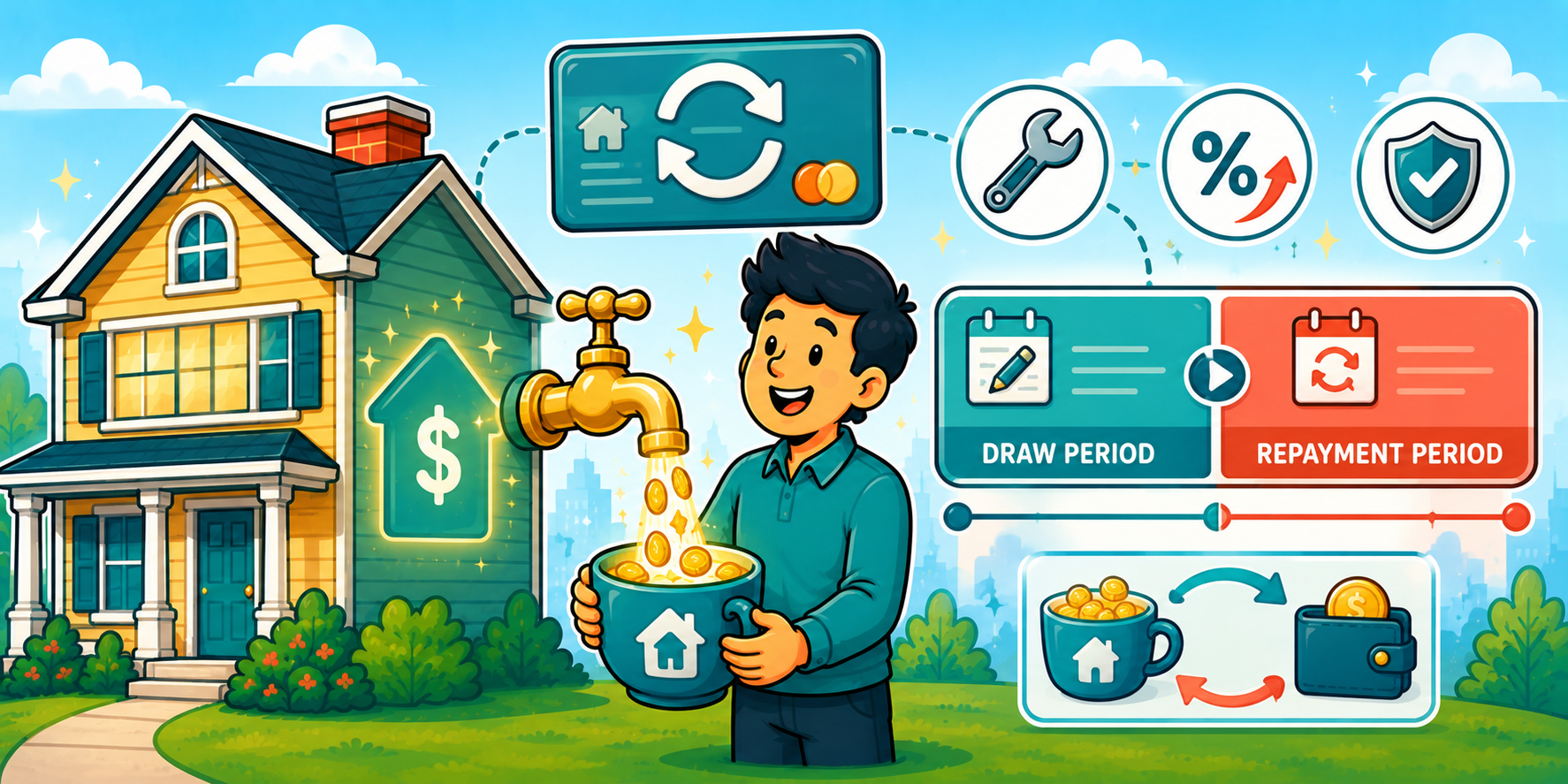
A HELOC lets you borrow against your home equity as needed, like a credit card secured by your house. Here's how it works, what it costs, and when it makes sense.
What Is a HELOC and How Does It Work for Homeowners?
You've built equity in your home. Now you're wondering what you can do with it. Maybe you want to renovate. Maybe you want a financial cushion for an uncertain market. Maybe you're looking at a large expense and wondering whether your home equity is the right tool to fund it.
A HELOC, which stands for home equity line of credit, is one of the most flexible ways to access that equity without replacing your existing mortgage. It's also one of the most misunderstood products in the mortgage market, with meaningful risks that buyers overlook when they focus only on the monthly payment.
Here's how a HELOC actually works, what it costs, how it compares to other equity access options, and how to decide whether it's the right tool for your situation.
What a HELOC Is
A HELOC is a revolving line of credit secured by your home equity. It works similarly to a credit card in structure: you're approved for a maximum credit limit, you draw from it as needed, you repay what you borrow, and you can draw again. The difference is that your home is the collateral rather than your creditworthiness alone.
Unlike a cash-out refinance, a HELOC does not replace your existing first mortgage. It sits behind it as a separate second lien. You keep your existing mortgage, your existing rate, and your existing payment structure. The HELOC is an additional borrowing facility layered on top.
This is the core reason HELOCs became the preferred equity access tool for homeowners who locked in low mortgage rates and don't want to give them up. A cash-out refinance would replace that low-rate first mortgage with a new loan at current rates on the entire balance. A HELOC lets you leave the first mortgage untouched and only borrow the incremental amount you actually need.
How a HELOC Is Structured
A HELOC has two distinct phases: the draw period and the repayment period.
The draw period is typically the first five to ten years of the line. During this time you can borrow up to your approved limit at any time, repay it, and borrow again as needed. Most HELOCs require interest-only payments during the draw period, meaning your minimum monthly payment covers only the interest on your outstanding balance. If you borrow $50,000 at a 6% rate, your monthly interest payment is calculated on that $50,000 balance.
The repayment period follows the draw period and typically runs ten to twenty years. During repayment, the line closes to new borrowing and the outstanding balance converts to a fully amortizing loan. Your payment now includes both principal and interest, which means it increases meaningfully compared to the interest-only draw period payment. This payment jump catches homeowners off guard when they haven't planned for it.
Understanding the repayment phase before you use the draw period heavily is essential. Borrowing the maximum during the draw period and then facing a fully amortizing payment on the full balance is a real financial shock that has contributed to homeowner distress in past market cycles.
How Much You Can Borrow
HELOC credit limits are based on your available home equity. Most lenders allow a combined loan-to-value ratio, called CLTV, of up to 80% to 85% across your first mortgage and HELOC combined.
Here's how the math works. If your home is worth $600,000 and your current mortgage balance is $350,000, your combined lien capacity at 80% CLTV is $480,000. Subtract your existing balance of $350,000 and your maximum HELOC credit line is approximately $130,000. At 85% CLTV that number rises to roughly $160,000.
Lenders order an appraisal or use an automated valuation to establish your home's current value. The HELOC limit is calculated from that number, not from your purchase price or your original loan balance.
The practical implication is that your borrowing capacity grows as your home appreciates and your mortgage balance decreases. Homeowners who purchased several years ago in Washington State's appreciating markets may have significantly more HELOC capacity than they realize.
HELOC Interest Rates: What You Need to Understand
This is where HELOCs carry their most significant risk and where buyers consistently underestimate exposure.
HELOC rates are almost universally variable. They're typically tied to the prime rate, which moves with Federal Reserve policy decisions, plus a margin set by the lender. When the prime rate goes up, your HELOC rate goes up. When it goes down, your rate goes down.
During periods of stable or declining rates, variable HELOC rates feel manageable. During periods of rising rates, a HELOC that started at a comfortable payment can become meaningfully more expensive in a relatively short time. Homeowners who drew heavily on their HELOCs during a low-rate period and then watched rates rise found themselves with significantly higher payments than their original borrowing decision contemplated.
Some lenders offer the ability to convert a portion of your HELOC balance to a fixed rate, which removes the variability risk on that portion. This option is worth asking about if rate predictability matters to your budget planning.
What a HELOC Costs to Open
Opening a HELOC involves upfront costs that vary by lender but are generally lower than a full mortgage origination. Common costs include an appraisal fee, title search fee, application fee, and in some cases an annual fee for maintaining the line.
Some lenders offer low or no-cost HELOCs as a competitive product, waiving certain fees in exchange for keeping the line open for a minimum period. If you close the line before that period ends, you may owe the waived costs back to the lender.
Ongoing costs include the interest on any outstanding balance and, in some cases, a nominal annual maintenance fee. There's typically no charge for the credit line itself during periods when you're not borrowing.
The lower opening cost compared to a cash-out refinance is part of the HELOC's appeal for smaller, staged, or uncertain borrowing needs. You pay to open the line and draw only what you need rather than originating a full mortgage on a lump sum you might not use entirely.
HELOC vs. Cash-Out Refinance: How to Choose
The choice between a HELOC and a cash-out refinance comes down to a handful of specific variables.
Choose a HELOC when your existing first mortgage rate is meaningfully below current market rates and you want to preserve it, when your borrowing need is staged or uncertain in amount, when flexibility to draw and repay repeatedly serves your purpose, and when the variable rate risk is manageable given your financial situation.
Choose a cash-out refinance when you need a large, one-time lump sum, when a fixed rate on the entire new balance gives you payment certainty, when your existing rate is already close to current market rates so preserving it isn't a significant advantage, or when the simplicity of a single loan payment is worth the trade-off.
Neither product is universally better. The right answer depends on your current rate, how much you need, how certain you are about the amount, how long you'll carry the balance, and how much rate variability your budget can absorb.
For many Washington State homeowners who locked in rates below the current market, a HELOC preserving the first mortgage rate while providing access to equity is the cleaner structure. For homeowners whose existing rate is already near market, a cash-out refinance that consolidates everything into one loan at a fixed rate can be the more straightforward path.
The Right Way to Think About a HELOC
A HELOC is a powerful tool when used with discipline and a clear repayment plan. It becomes a financial liability when treated as a permanent, low-payment borrowing facility without accounting for the repayment period or variable rate exposure.
The homeowners who use HELOCs most effectively are the ones who borrow for a specific purpose, have a defined repayment timeline that extends well before the draw period ends, and treat the variable rate as a risk to manage rather than an assumption to ignore.
Opening a HELOC you might need is also a legitimate strategy. Establishing the line before you need it, even if the balance sits at zero, gives you liquidity capacity that takes time to set up when an opportunity or urgent expense arises.
Your Equity Has Options
Building equity is only half the equation. Knowing how to access it strategically, whether through a HELOC, a cash-out refinance, or simply letting it compound toward payoff, is what separates passive homeownership from intentional wealth building.
A 15-minute conversation with a licensed broker can tell you exactly how much HELOC capacity you have, what a current rate looks like on your specific equity position, and whether a HELOC or another product better fits what you're trying to accomplish.
Ready to find out how much equity you have access to and what the right structure is? Schedule a free 15-minute call and we'll walk through your options.