Cash-Out Refinance Explained: How to Access Your Home Equity
By Terry Leinneweber · June 24, 2026
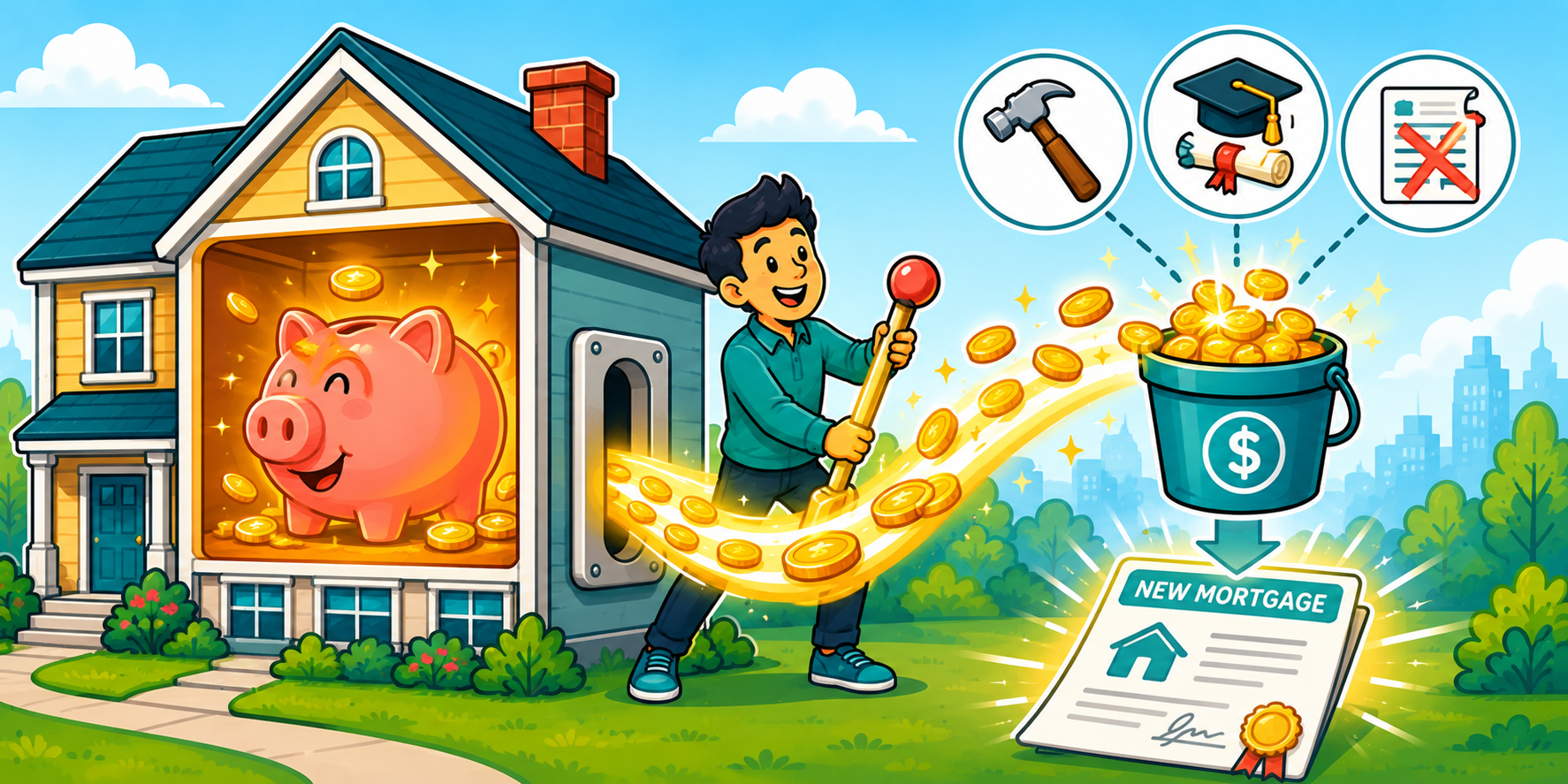
A cash-out refinance lets you convert home equity into cash. Here's how it works, what it costs, and how to decide if it's the right move for your situation.
Cash-Out Refinance Explained: How to Access Your Home Equity
If you've owned your home for a few years and values in your area have risen, there's a good chance you're sitting on equity you haven't thought much about. That equity isn't doing anything for you while it sits in the walls of your house. A cash-out refinance is one of the most direct ways to put it to work.
But like every mortgage decision, a cash-out refinance comes with trade-offs that aren't obvious until you look at the full picture. Done at the right time for the right reason, it's a powerful financial tool. Done carelessly, it's a way to erase years of equity progress in a single transaction.
Here's how it works, what it actually costs, and how to know whether it makes sense for your situation.
What a Cash-Out Refinance Is
A cash-out refinance replaces your existing mortgage with a new, larger loan. The difference between your new loan amount and your current balance is paid to you in cash at closing.
Here's a straightforward example. Your home is worth $600,000. Your current mortgage balance is $350,000. You have $250,000 in equity. A cash-out refinance might allow you to borrow up to 80% of the home's value, which is $480,000. Subtract your existing balance of $350,000 and you receive $130,000 in cash at closing, minus closing costs.
Your new mortgage is $480,000 at whatever the current rate environment is, replacing your old loan entirely. Your monthly payment is recalculated on the new balance and the new rate.
You're not borrowing against your home in addition to your mortgage. You're restructuring your entire mortgage at a higher balance and receiving the difference as cash.
What the Cash Can Be Used For
There are no restrictions on how you use the proceeds from a cash-out refinance. Common uses include home renovations and improvements, paying off high-interest debt, funding education costs, investing in additional real estate, covering major medical expenses, or building a financial reserve.
Home improvements are one of the most financially sound uses because they can increase the value of the property you're borrowing against, partially offsetting the equity you're extracting. A kitchen renovation, bathroom remodel, or accessory dwelling unit addition that increases value creates a more defensible equity position than spending the proceeds on something that produces no return.
Debt consolidation is another common use, particularly for homeowners carrying high-interest credit card balances. Converting 20% interest credit card debt into a mortgage rate can produce meaningful monthly savings. The risk, however, is converting unsecured debt into secured debt. If you fall behind on credit card payments your credit suffers. If you fall behind on a mortgage that now carries your former credit card balance, you risk your home. The discipline required to avoid running the credit cards back up after consolidation is real and worth being honest with yourself about.
How Much Equity You Can Access
Most conventional lenders allow a maximum loan-to-value ratio of 80% on a cash-out refinance. That means your new loan cannot exceed 80% of your home's current appraised value. The remaining 20% stays in the home as equity.
This 80% ceiling is the most common limit, but it's not universal. Some loan programs allow higher LTV cash-out refinancing with additional mortgage insurance or at higher rates. FHA cash-out refinances allow up to 80% LTV. VA cash-out refinances for eligible veterans allow up to 90% in some cases, which is one of the most generous cash-out access points available in the market.
The actual amount you can access is determined by three variables: your current home value, your existing loan balance, and the maximum LTV your chosen loan program allows. Your lender will order a new appraisal to establish current value, which is the starting point for the entire calculation.
What a Cash-Out Refinance Actually Costs
This is where many homeowners underestimate the transaction. A cash-out refinance is a full mortgage origination. You pay closing costs on the entire new loan amount, not just the cash-out portion.
Closing costs on a refinance typically run between 2% and 5% of the new loan amount. On a $480,000 new loan, that's $9,600 to $24,000 in closing costs, which are either paid out of pocket at closing or rolled into the new loan balance, effectively reducing the cash you receive.
Rolling closing costs into the loan is common but worth understanding clearly. If you roll $12,000 in closing costs into a $480,000 loan, your actual loan balance becomes $492,000 and your cash received drops accordingly. You're borrowing to pay for the cost of borrowing.
Your new rate is also likely different from your existing rate. If you originated your current mortgage when rates were lower than today, a cash-out refinance means giving up that rate on your entire remaining balance, not just the new cash portion. This is the most significant trade-off in the current rate environment and one that deserves direct, honest math before you proceed.
The Rate Trade-Off: When It Works and When It Doesn't
If your existing mortgage rate is meaningfully below current market rates, extracting equity through a cash-out refinance means trading a low rate on your entire balance for a higher rate on a larger balance. The monthly payment impact can be significant.
In that scenario, a home equity line of credit, commonly called a HELOC, is often a more cost-effective alternative for accessing equity without disturbing your existing first mortgage rate. A HELOC sits behind your current mortgage as a separate line of credit. You keep your existing rate on the primary loan and only borrow what you need from the HELOC when you need it.
The trade-off with a HELOC is that it typically carries a variable rate tied to the prime rate, which means your payment can change. For large, one-time needs where you want predictable repayment, a cash-out refinance at a fixed rate may still be preferable despite the rate trade-off on the primary balance.
The honest answer is that neither product is universally better. The right choice depends on your current rate, your current balance, how much you need, how long you'll need it, and whether rate predictability or preservation of your existing terms matters more to you.
How a Cash-Out Refinance Affects Your Equity and Amortization
Every dollar you pull out in a cash-out refinance is a dollar you've already built and are now borrowing back. Your equity resets to the minimum required by your lender's LTV requirement, typically 20%, and you restart the amortization clock on a higher balance at whatever the current rate is.
If you were five years into a 30-year mortgage, a cash-out refinance into a new 30-year loan extends your total loan timeline. You're not five years closer to payoff anymore. You're back at year zero on a new loan.
Some lenders offer 20-year or 15-year refinance terms that preserve more of your payoff progress. If preserving your timeline to payoff matters to you, discussing term options with your lender before defaulting to a 30-year refinance is worth the conversation.
The Right Reason to Do a Cash-Out Refinance
The clearest signal that a cash-out refinance makes sense is when the return on what you're doing with the money exceeds the cost of extracting it.
A renovation that adds more value than it costs, a debt consolidation that produces genuine net savings and eliminates the behavior that created the debt, or a real estate investment that generates returns above your mortgage cost are all defensible uses.
Extracting equity to fund lifestyle spending, discretionary purchases, or anything that doesn't produce a return or eliminate a higher-cost obligation is using your home as an ATM. The equity you pull out doesn't grow back on its own. You have to earn it back through appreciation and payments, which takes time.
The most useful question to ask before a cash-out refinance is not whether you can do it. It's whether the specific use of the cash justifies the full cost of the transaction, including the rate trade-off, the closing costs, and the reset of your equity position.
Want to run the real numbers on a cash-out refinance for your specific home and situation? Schedule a free 15-minute call and we'll build an honest comparison for you.