What Does a Mortgage Payment Actually Include? — full breakdown of monthly mortgage costs
By Terry Leinneweber · May 6, 2026
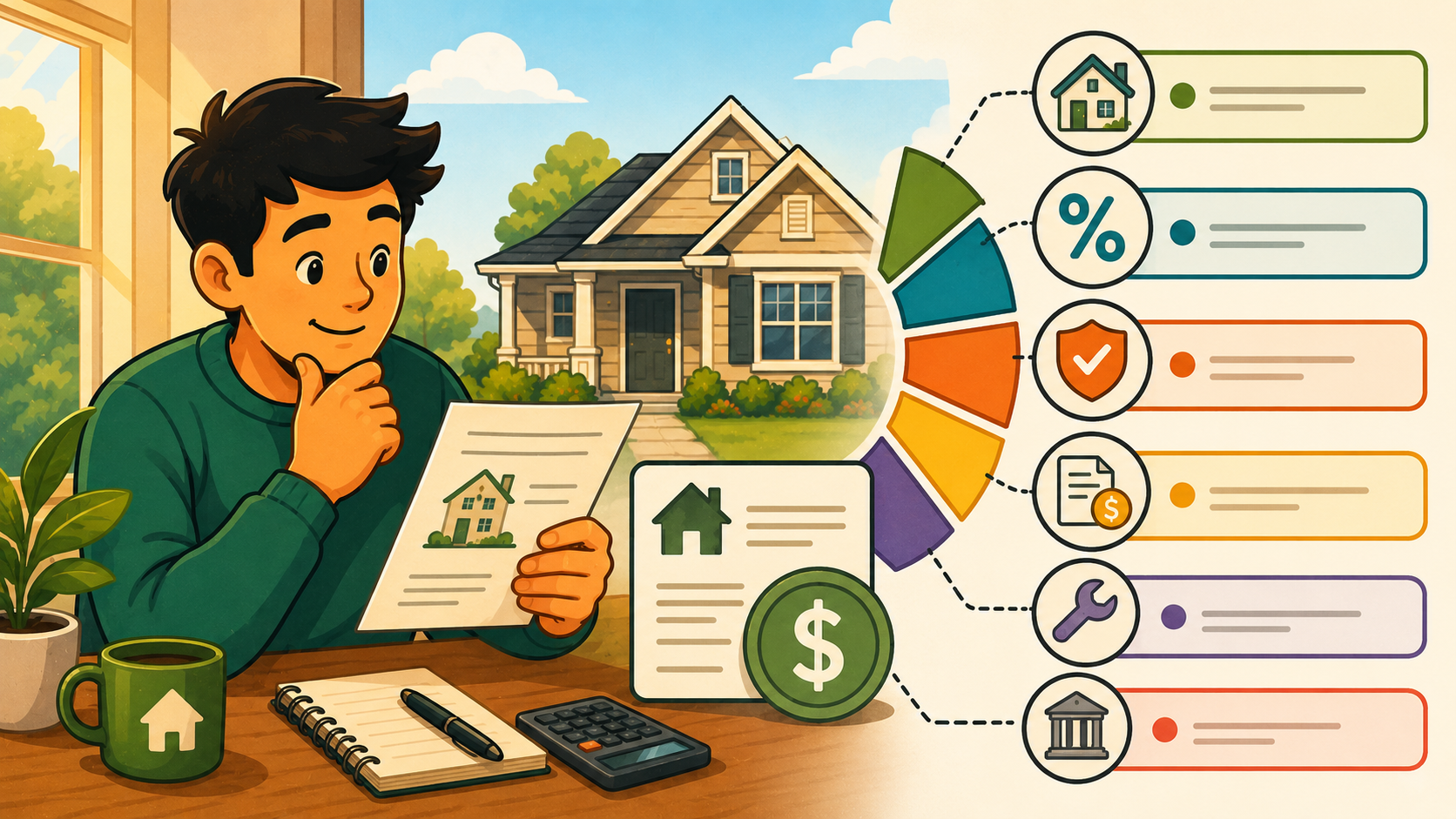
Your mortgage payment is more than principal and interest. Here's every cost that goes into your monthly payment and how to plan for all of it.
What Does a Mortgage Payment Include? A Full Breakdown of Monthly Costs
Most first-time buyers focus on the loan amount. They find a home, look up the price, and think, "I just need to know what my payment will be."
Then they get to closing and realize their payment is several hundred dollars higher than what they expected.
That gap isn't hidden fees or fine print. It's the parts of a mortgage payment that nobody explained upfront. Your monthly payment is not just the cost of borrowing money. It is four separate things bundled into one number, and sometimes a fifth.
Here is exactly what you are paying every month, what each piece covers, and how to know what to actually budget for before you fall in love with a house.
The Four Components of a Mortgage Payment: PITI
The standard acronym is PITI: Principal, Interest, Taxes, and Insurance. Every homeowner with a mortgage pays all four. Here is what each one means.
Principal
Principal is the actual loan balance, the amount you borrowed to buy the home. Each monthly payment chips away at that balance.
In the early years of a 30-year mortgage, very little of your payment goes toward principal. Most of it goes toward interest. This is how amortization works: the lender collects its interest cost up front, and your principal paydown accelerates over time. By the final years of the loan, almost your entire payment goes toward principal.
This is one reason many buyers choose a 15-year mortgage when they can afford the higher payment. You build equity faster, and you pay significantly less interest over the life of the loan.
Interest
Interest is the cost of borrowing the money. It is expressed as an annual percentage rate, or APR, and it determines how much you pay the lender on top of repaying what you borrowed.
On a $350,000 loan at 5-6%, a 30-year term produces a principal and interest payment of roughly 1600-1800$. Shorten that to a 15-year term and the payment is higher each month, but the total interest paid over the life of the loan drops dramatically.
Your interest rate is determined by your credit score, loan type, down payment amount, and market conditions at the time you lock. A higher credit score almost always means a lower rate, which is why working on your credit before you apply is one of the most valuable things you can do.
Taxes
Property taxes are collected by your local government and are based on the assessed value of your home. They vary widely depending on where you live. A home in one county might carry $200 per month in property taxes. The same-priced home in a neighboring county might carry $600.
Most lenders require you to pay property taxes through an escrow account. That means your lender collects one-twelfth of your annual tax bill every month along with your principal and interest payment, holds that money in escrow, and pays your tax bill on your behalf when it comes due.
You do not pay taxes directly in this setup. Your lender handles it. But that cost is real, and it is part of your monthly payment.
Insurance
Homeowner's insurance protects the structure and contents of your home against damage, fire, theft, and liability. Lenders require it because the home is the collateral for the loan. If the house burns down and you have no insurance, the lender has no security.
Like property taxes, most lenders collect homeowner's insurance premiums monthly through escrow. The annual cost depends on your location, the home's age and size, and the coverage level you choose. In most markets, expect somewhere between $100 and $250 per month, though high-risk areas like coastal zones or wildfire-prone regions can run significantly higher.
LINK: "How your escrow account works"
The Fifth Component: Mortgage Insurance
Mortgage insurance is not part of PITI, but it is part of your payment if your down payment is below a certain threshold. And it catches a lot of buyers off guard.
PMI on Conventional Loans
If you put less than 20 percent down on a conventional loan, you will pay private mortgage insurance, or PMI. This protects the lender, not you, in case you default.
PMI typically costs between 0.5 percent and 1.5 percent of the loan amount per year, paid monthly. On a $350,000 loan, that could add $145 to $435 to your payment every month.
The good news: PMI is not permanent on a conventional loan. Once your loan balance drops to 80 percent of the home's original value, you can request cancellation. Once it drops to 78 percent, federal law requires your lender to cancel it automatically.
MIP on FHA Loans
FHA loans, which allow down payments as low as 3.5 percent and credit scores as low as 580, carry a different version of mortgage insurance called MIP, or mortgage insurance premium.
FHA MIP works in two parts. There is an upfront MIP of 1.75 percent of the loan amount, which is typically rolled into the loan. And there is an annual MIP, paid monthly, that ranges from 0.15 percent to 0.75 percent depending on your loan size and term.
The key difference between FHA MIP and conventional PMI: for most FHA borrowers putting less than 10 percent down, MIP stays for the life of the loan. It does not automatically cancel the way PMI does. That is one of the reasons buyers with stronger credit and enough down payment often choose conventional financing instead.
VA and USDA Loans
If you are an eligible veteran, active-duty service member, or surviving spouse, a VA loan requires no down payment and no monthly mortgage insurance at all. There is a one-time funding fee that can be rolled into the loan, but no ongoing PMI equivalent.
USDA loans, available in eligible rural and suburban areas, also carry no monthly mortgage insurance in the traditional sense. They have an annual guarantee fee that is divided into monthly payments, but it is typically lower than FHA MIP.
What Your Pre-Approval Letter Does Not Show You
Here is the part that trips up buyers consistently.
Your pre-approval is based on your loan amount. It tells you the maximum you qualify for in principal and interest. It does not automatically calculate your taxes, insurance, or mortgage insurance, because those numbers depend on the specific property you buy and where it is located.
Two homes at the same price in different zip codes can have $400 or more difference in monthly payment, purely because of property tax rates.
Before you make an offer, ask your loan officer to build a full payment estimate for the specific property you are considering. That number, principal plus interest plus taxes plus insurance plus any mortgage insurance, is your real monthly cost. Budget from that number, not the pre-approval ceiling.
The Bottom Line
Your mortgage payment is not a single number. It is a combination of your loan repayment, the cost of borrowing, your property tax obligation, your homeowner's insurance, and in many cases, mortgage insurance on top of all of that.
Knowing what goes into that payment before you start shopping gives you a real budget to work from. It keeps you from falling in love with a home that stretches you thinner than you realized.
If you want to see a full payment breakdown on a specific loan amount or property before you start making offers, that is exactly the kind of conversation worth having early.
Ready to get a real number, not just a pre-approval ceiling?
Schedule a free 15-minute call and we will walk through every line of your monthly payment before you make a single offer.