Property Taxes in Washington State: What Home Buyers Need to Know
By Terry Leinneweber · June 20, 2026
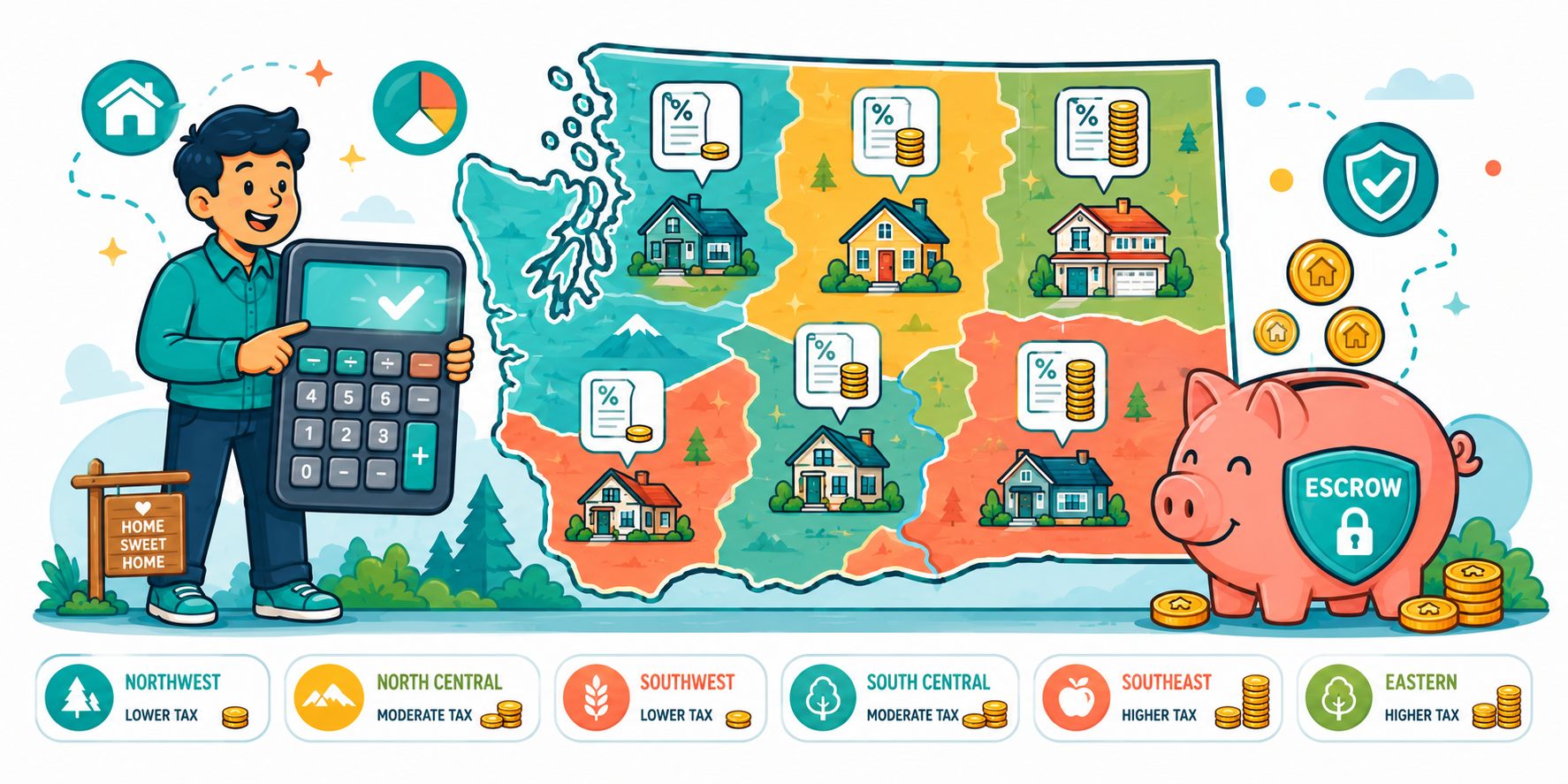
Property taxes affect your monthly mortgage payment and your budget for years. Here's how Washington calculates them, what you'll pay, and how to plan for changes.
Property Taxes in Washington State: What Home Buyers Need to Know
Most buyers focus on the interest rate when they're calculating what a home will cost them each month. What they underestimate, sometimes significantly, is the property tax line.
In Washington State, property taxes vary widely by county, by city, and even by specific location within a city. Two homes with identical purchase prices in different parts of the state can carry meaningfully different annual tax bills. And because property taxes are built into your monthly mortgage payment through escrow, understanding them before you buy is essential to building an accurate budget.
Here's how Washington property taxes work, what affects your bill, and what to expect when your assessment changes after you close.
How Property Taxes Work in Washington State
Washington State has no personal income tax. The state relies more heavily on property taxes and sales tax to fund public services than most other states. That trade-off matters to homeowners because it means property tax rates in Washington, while not the highest in the country, are a meaningful part of your annual housing cost.
Property taxes in Washington are calculated by multiplying your property's assessed value by the total tax rate applied to it. That rate is a combination of levies from multiple taxing districts, including the state, your county, your city or municipality, your school district, fire district, library district, and any special purpose districts that apply to your location.
The result is your annual tax bill, which is typically paid in two installments: April 30 and October 31. Your mortgage servicer collects a portion of your estimated annual tax bill with every monthly payment and holds it in escrow, then pays the tax authority directly when each installment is due.
What Determines Your Property Tax Bill
Three things drive your annual property tax amount.
Assessed value. The Washington State Department of Revenue requires county assessors to value properties at 100% of their fair market value. In practice, assessed values often lag behind rapidly appreciating markets, which can work in your favor in the short term. After a sale, however, your county assessor will likely update your assessed value based on the purchase price, which can result in a higher bill in your first full year of ownership than the previous owner was paying.
Levy rate. The combined levy rate for your specific location is determined by adding up the individual rates of every taxing district that applies to your property. This rate is expressed in dollars per $1,000 of assessed value. A property in a location with a combined levy rate of $10 per $1,000 would owe $10,000 annually on a $1,000,000 assessed value.
Special levies and voter-approved measures. Washington voters regularly approve levies for schools, parks, transportation, and other public services. Each approved levy adds to the total rate applied to properties in that district. Neighborhoods in active levy districts can see their rates change meaningfully from year to year based on what voters approve.
What Property Tax Rates Look Like Across Washington
Tax rates vary significantly by location, which is one reason two comparable homes in different counties can carry very different monthly payments.
King County, which includes Seattle and the Eastside, carries some of the higher effective rates in the state when combined with city and school levies. Buyers purchasing in Seattle, Bellevue, Kirkland, or Redmond should budget for effective rates that are among the higher end of what Washington buyers encounter.
Pierce County, Snohomish County, and Kitsap County have their own rate structures that differ from King County. Rural Eastern Washington counties tend to have lower assessed values but vary in levy structure.
The only accurate way to know what you'll pay on a specific property is to look up the current tax bill for that parcel. Your real estate agent can pull this information, and it should appear on every listing. Review it before you make an offer, not after you've calculated your budget around a payment that didn't include accurate tax figures.
How Property Taxes Flow Through Your Monthly Payment
Unless you own your home free and clear, your property taxes are almost certainly collected and paid through your escrow account. Your lender calculates the estimated annual tax bill, divides it by 12, and adds that amount to your monthly principal and interest payment.
This is the full mortgage payment most buyers refer to when they say PITI, which stands for principal, interest, taxes, and insurance. The tax and insurance portions are held in escrow until the payment dates arrive, at which point your servicer pays them on your behalf.
Lenders are required to maintain a minimum cushion in your escrow account, typically two months of estimated payments, to cover unexpected increases. This is why your escrow account balance never drops to zero even after your tax payment goes out.
What Happens When Your Assessment Changes
This is the part that surprises first-time buyers most often, typically in the form of an escrow shortage notice arriving in their mailbox a year after closing.
When you purchase a home, the county assessor updates the assessed value based on your purchase price. If the previous owner had been assessed at a significantly lower value, your first full year's tax bill will be higher than what was reflected in the seller's last tax statement.
Your lender's escrow analysis at the time of closing is based on the most recent available tax bill. If that bill was calculated on the prior owner's lower assessed value, your escrow payment will be set too low to cover the actual bill once reassessment occurs.
The result is an escrow shortage, where your servicer paid out more than the collected amount and now needs to recover the difference. Servicers typically offer two options: pay the shortage as a lump sum or spread the recovery across a 12-month adjustment period added to your monthly payment.
Neither option is a crisis. But buyers who aren't expecting it find an escrow shortage letter confusing and alarming. Now you know to expect it and plan for it.
Washington's Senior and Exemption Programs
Washington State offers property tax relief programs for certain qualifying homeowners. The most significant is the senior citizen and disabled persons property tax exemption, which reduces assessed value for qualifying low and moderate income homeowners who are 61 or older, or who are retired due to disability.
There are also programs for veterans with service-connected disabilities and for certain agricultural and forestry land classifications.
These programs are worth knowing about if you or a family member may qualify, but they apply to a specific subset of buyers and are not broadly available to working-age homebuyers purchasing a primary residence without qualifying circumstances.
How to Build Property Taxes Into Your Budget Accurately
The single most useful thing you can do before making an offer is to look up the actual current tax bill on the specific property you're considering, then calculate whether that amount, divided by 12, is already reflected in the payment estimate your lender gave you.
If your lender quoted you a payment that includes taxes, verify which tax figure they used. If it was based on the prior owner's lower assessed value, ask your lender to model the payment using a tax estimate based on your purchase price. That's the more accurate number to budget around.
Building your budget on an accurate tax figure from the start prevents escrow surprises and ensures the payment you're planning for is the one you'll actually be making.
Property Taxes Are Predictable When You Know the Rules
Property taxes aren't a mystery once you understand how they're calculated, how they flow through escrow, and why they can change in your first year of ownership. They're a predictable cost that you can research, model, and plan for before you close.
Buyers who take ten minutes to look up the tax bill on a property before they make an offer are never surprised by what shows up in their escrow account after closing.
Have questions about how property taxes will affect your monthly payment on a specific home? Schedule a free 15-minute call and we'll build an accurate payment picture with you.