What Is a Home Appraisal and What Happens If It Comes In Low?
By Terry Leinneweber · June 7, 2026
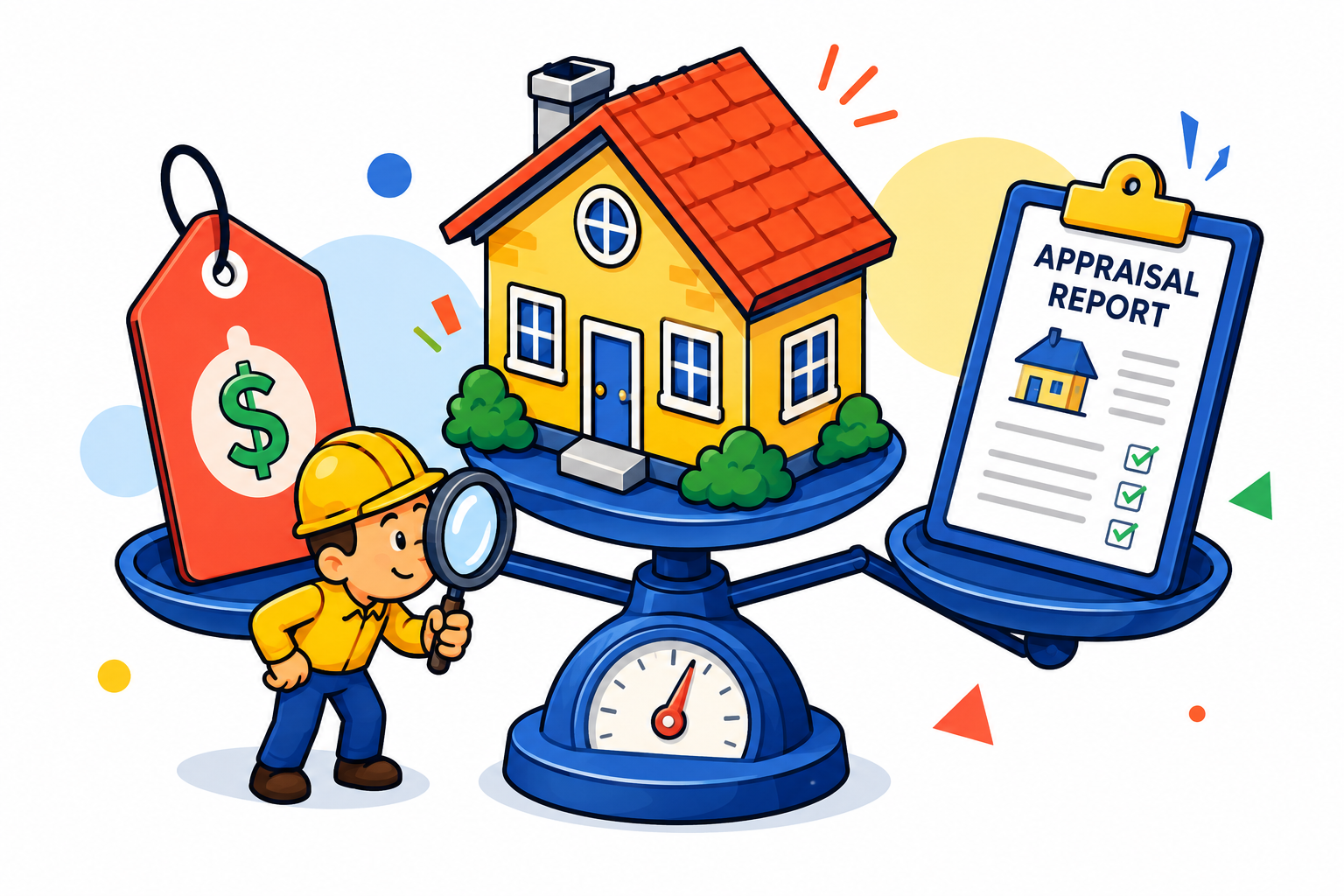
Your lender requires a home appraisal before they'll fund your loan. Here's what appraisers look for, what the report means, and what to do if the number is too low.
What Is a Home Appraisal and What Happens If It Comes In Low?
You found the home. Your offer was accepted. Your lender is moving forward. And then the appraisal comes back lower than the purchase price.
For a lot of buyers, this is the moment where a transaction either holds together or falls apart. Yet most buyers don't learn how appraisals work until they're already inside one.
That's backwards. Understanding what an appraisal is, how lenders use it, and what your options are when the number comes in low gives you real leverage at one of the most stressful points in the buying process. Here's how it works.
What a Home Appraisal Actually Is
A home appraisal is an independent estimate of a property's market value, ordered by your lender and conducted by a licensed appraiser. It is not the same as a home inspection. The inspection evaluates the condition of the home. The appraisal establishes what it's worth.
Lenders require an appraisal on almost every purchase transaction because they're using the home as collateral for the loan. Before they commit to lending $450,000 on a property, they need an objective opinion confirming that the property is actually worth $450,000. If you default and the home needs to be sold, the lender needs to know they can recover the loan amount.
You pay for the appraisal, typically between $500 and $900 in Washington State depending on property type and location. It's ordered by your lender through an appraisal management company to keep the process independent and compliant with federal guidelines.
How the Appraiser Determines Value
The appraiser visits the property, documents its condition, size, features, and location, and then compares it to recently sold homes nearby. These comparable sales, called comps, are the foundation of the appraisal report.
The appraiser selects three to five comps that are as similar as possible to the subject property: similar square footage, similar age, similar lot size, similar neighborhood. Then they make adjustments for differences. If the subject property has a garage and a comp doesn't, the appraiser adds value. If the comp has a newer kitchen and the subject doesn't, they subtract.
The result is an adjusted value for each comp, which the appraiser reconciles into a final opinion of value for the subject property.
The appraiser is not trying to hit the purchase price. They're trying to determine what the market would actually pay. Those two numbers are often the same. When they're not, you have an appraisal gap.
What an Appraisal Gap Is and Why It Matters
An appraisal gap occurs when the appraised value comes in below the agreed purchase price. If you're buying a home for $520,000 and the appraiser values it at $490,000, you have a $30,000 gap.
This matters because your lender bases the loan on the lower of the purchase price or the appraised value. If the appraisal comes in low, your lender won't simply lend more to cover the difference. They'll lend based on the appraised value, and the gap becomes your problem to solve.
Using the example above, if you planned to put 10% down on a $520,000 purchase, your loan was going to be $468,000. But now the lender will only lend up to 90% of $490,000, which is $441,000. To close the deal at $520,000, you'd need to bring an additional $27,000 to the table out of pocket, on top of your original down payment.
That's a significant number. Here's what you can do about it.
LINK: Why the appraised value, not the purchase price, is what lenders actually use to calculate your loan
Your Four Options When an Appraisal Comes In Low
Renegotiate the purchase price. This is the cleanest resolution. You go back to the seller with the appraisal report and ask them to reduce the price to the appraised value. Sellers in a softening market are often willing to negotiate. Sellers in a highly competitive market may not budge. But the appraisal gives you documented leverage to make the ask.
Cover the gap with cash. If you have the reserves and you want the home badly enough, you can make up the difference out of pocket. This effectively means you're paying above market value as determined by the appraiser, which is a choice some buyers make willingly in competitive situations.
Split the difference. You and the seller meet somewhere in the middle. The seller drops the price partially, and you bring additional cash to cover the remaining gap. This is a common outcome in negotiations where both parties want to close.
Walk away. If your purchase agreement includes an appraisal contingency, a low appraisal gives you the right to exit the transaction and recover your earnest money. This is the protection that contingencies exist to provide. If you waived the appraisal contingency to make your offer more competitive, walking away without penalty is no longer an option.
How to Reduce the Risk of an Appraisal Problem
You can't control what an appraiser concludes, but you can reduce the likelihood of a surprise.
Before you make an offer, ask your broker or agent to pull recent comps for the property. If the asking price is supported by what similar homes have actually sold for in the past 90 days, the appraisal is unlikely to come in low. If the price is stretching beyond what comps support, you're taking on real appraisal risk, especially in a market where values are flattening or declining.
Your lender can also review comps with you before you're under contract. This isn't something every buyer thinks to ask for, but it's a five-minute conversation that can save you from a significant problem three weeks into escrow.
The Appraisal Is Not the Enemy
A low appraisal feels like a setback. In some cases it is. But it can also be the thing that keeps you from overpaying for a home in a market where the seller's asking price outran the data.
Buyers who understand the appraisal process go into it without panic. They know what the report means, they know what their options are, and they know which contingencies protect them if the number comes in short. That clarity is worth a lot in the middle of a transaction.
Have questions about the appraisal process on your specific purchase? Schedule a free 15-minute call and we'll walk through exactly where you stand.