Should I Buy a Home Now or Wait? A First-Time Buyer's Honest Guide
By Terry Leinneweber · May 2, 2026
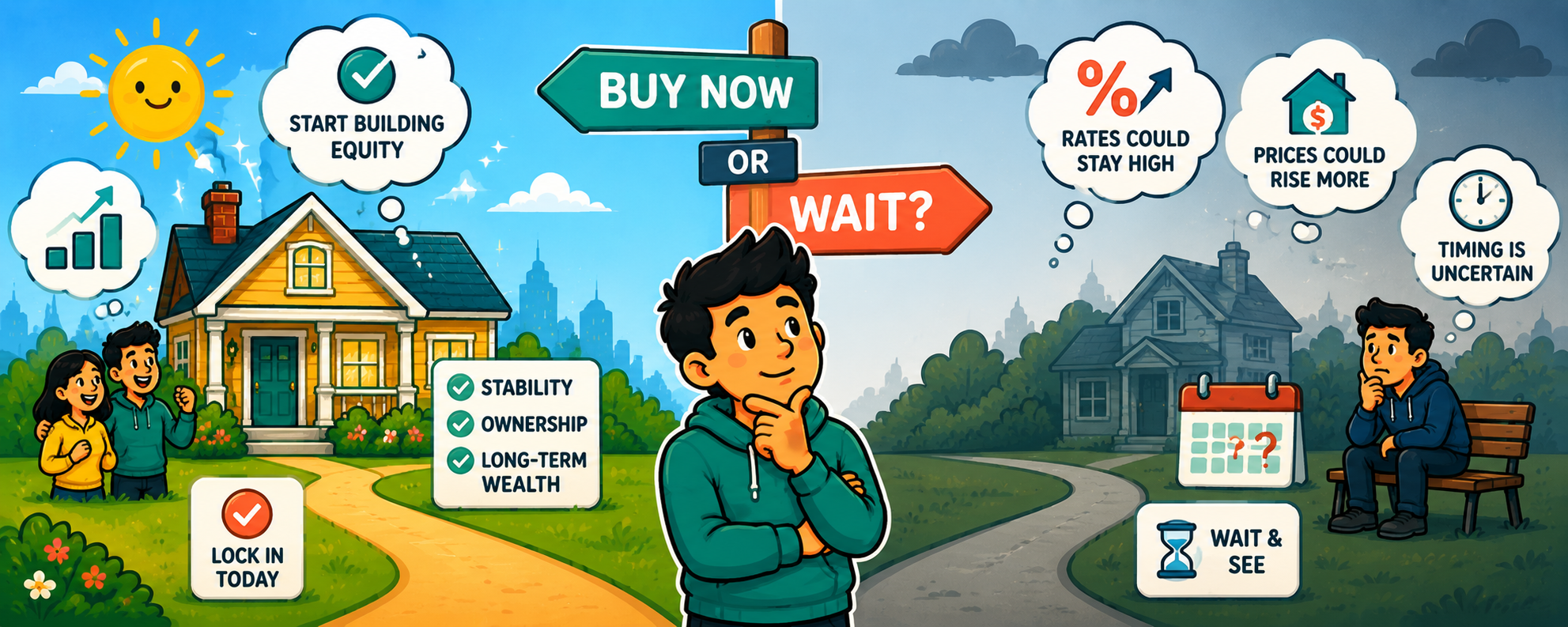
The market's confusing right now. Here's a straightforward way to think about timing your first purchase — without the noise.
Should I Buy a Home Now or Wait? A First-Time Buyer's Honest Guide
It's the right question. But the honest answer isn't what most people expect.
There's no universally "right" time to buy a home. There's only the right time for you, based on your finances, your goals, and how long you plan to stay. This guide will help you figure out which side of that line you're on.
Why "Timing the Market" Usually Backfires
Here's the trap first-time buyers fall into: waiting for rates to drop, prices to fall, or conditions to feel perfect. The problem is those things rarely happen at the same time, and waiting has a real cost.
Every month you rent instead of own, you're building someone else's equity, not yours. You're also not locking in a payment. And if rates do drop significantly, demand typically surges, which pushes prices up and puts you in competition again.
That doesn't mean you should rush. It means the question shouldn't be "what's the market doing?" It should be "what am I ready for?"
The 5 Things That Actually Determine If You Should Buy Now
1. Your Credit Score
Your credit score is the single biggest factor controlling what rate you'll qualify for. The difference between a 640 score and a 740 score can be hundreds of dollars per month on the same loan.
If your score is below 580, you won't qualify for most programs. At 580 or above, you can access an FHA loan, a government-backed mortgage that allows as little as 3.5% down. At 620+, conventional loan options open up. At 740+, you're in the best rate tiers.
Takeaway: Pull your credit report at annualcreditreport.com, it's free. If your score needs work, a 6 to 12 month improvement sprint can save you significantly over the life of the loan.
2. Your Down Payment and Closing Costs
You don't need 20% down. That's one of the most persistent myths in home buying.
Here's the reality:
-- FHA loans require 3.5% down with a 580+ credit score.
-- Conventional loans can go as low as 3% down for first-time buyers.
-- VA loans (for eligible veterans and active military) require zero down, and come with no private mortgage insurance. PMI is the extra monthly fee lenders charge when your down payment is under 20%.
-- USDA loans also allow zero down for eligible rural and suburban areas.
Beyond the down payment, plan for closing costs, typically 2 to 5% of the loan amount. Some sellers will cover part of these in a negotiated deal. There are also Down Payment Assistance (DPA) programs available through many states and counties that can cover your down payment entirely when layered with an FHA or conventional loan.
Takeaway: Talk to a loan officer before assuming you don't have enough. You may be closer to ready than you think.
3. Your Debt-to-Income Ratio (DTI)
DTI, your debt-to-income ratio, is how lenders measure whether you can handle a mortgage on top of your existing monthly obligations. It's calculated by dividing your total monthly debt payments (car payment, student loans, credit cards, etc.) by your gross monthly income.
Most loan programs want to see your DTI below 43 to 45%. Some programs allow higher with compensating factors like strong savings or a high credit score.
If your DTI is tight, you have two levers: increase your income, or pay down existing debt before applying.
Takeaway: A quick DTI estimate takes about five minutes. Add up your monthly debt payments, divide by your gross monthly income, and multiply by 100. That percentage tells you where you stand.
4. How Long You Plan to Stay
Buying a home has upfront costs, closing costs, moving expenses, and immediate repairs. It typically takes 3 to 5 years to recoup those costs through equity gain and stability.
If you're planning to relocate in two years, buying probably doesn't pencil out. If you're planting roots, new job, growing family, tired of moving, the math shifts strongly in your favor.
An adjustable-rate mortgage (ARM) can make sense if you know you'll sell or refinance within 5 to 7 years. ARMs offer a lower introductory rate for that initial period before adjusting. For buyers planning to stay long-term, a fixed-rate loan (15, 20, or 30-year) locks your payment in permanently regardless of what rates do.
Takeaway: Five years is usually the minimum horizon where buying wins. Know your timeline before you commit.
5. Your Job Stability
Lenders want to see a consistent employment history, typically two years with the same employer or in the same industry. If you're self-employed, the documentation requirements are different, but there are loan programs built specifically for you. Bank Statement loans, for example, qualify you based on 12 to 24 months of bank deposits instead of W-2s, so your tax write-offs don't work against you.
If you just started a new job, some programs allow exceptions, especially if you're staying in the same field. It's worth asking before assuming you can't qualify.
Takeaway: Job changes aren't automatic disqualifiers. The specifics matter more than the surface situation.
So, Should You Buy Now or Wait?
Here's the honest framework.
Buy now if:
-- Your credit is 580 or above (and ideally 640+).
-- You have or can get down payment funds, even with assistance.
-- Your DTI is under 45%.
-- You plan to stay 5+ years.
-- Your income is stable and documentable.
Wait, but use the time strategically, if:
-- Your credit needs repair. Six to 12 months of focused effort can make a real difference.
-- You're carrying high-interest debt that's squeezing your DTI.
-- You're in a transitional period, new job, new city, or an unclear timeline.
-- You need more time to save for closing costs.
Waiting isn't failure. But waiting without a plan is just renting indefinitely. If you're not ready today, build a 90-day action list: score, savings, and debt, in that order.
The Bottom Line
The best time to buy isn't when rates hit a number you read in an article. It's when your credit, savings, debt load, and life timeline line up. That's the window that actually matters.
A good mortgage broker won't tell you to rush. They'll show you exactly where you stand, and what it would take to get to "yes" if you're not there yet.
Ready to find out where you actually stand?
Schedule a free 15-minute call and get a clear picture of your buying timeline, no pressure, no obligation.