VA Loan vs. Conventional: Which Is Better for Washington Veterans?
By Terry Leinneweber · May 22, 2026
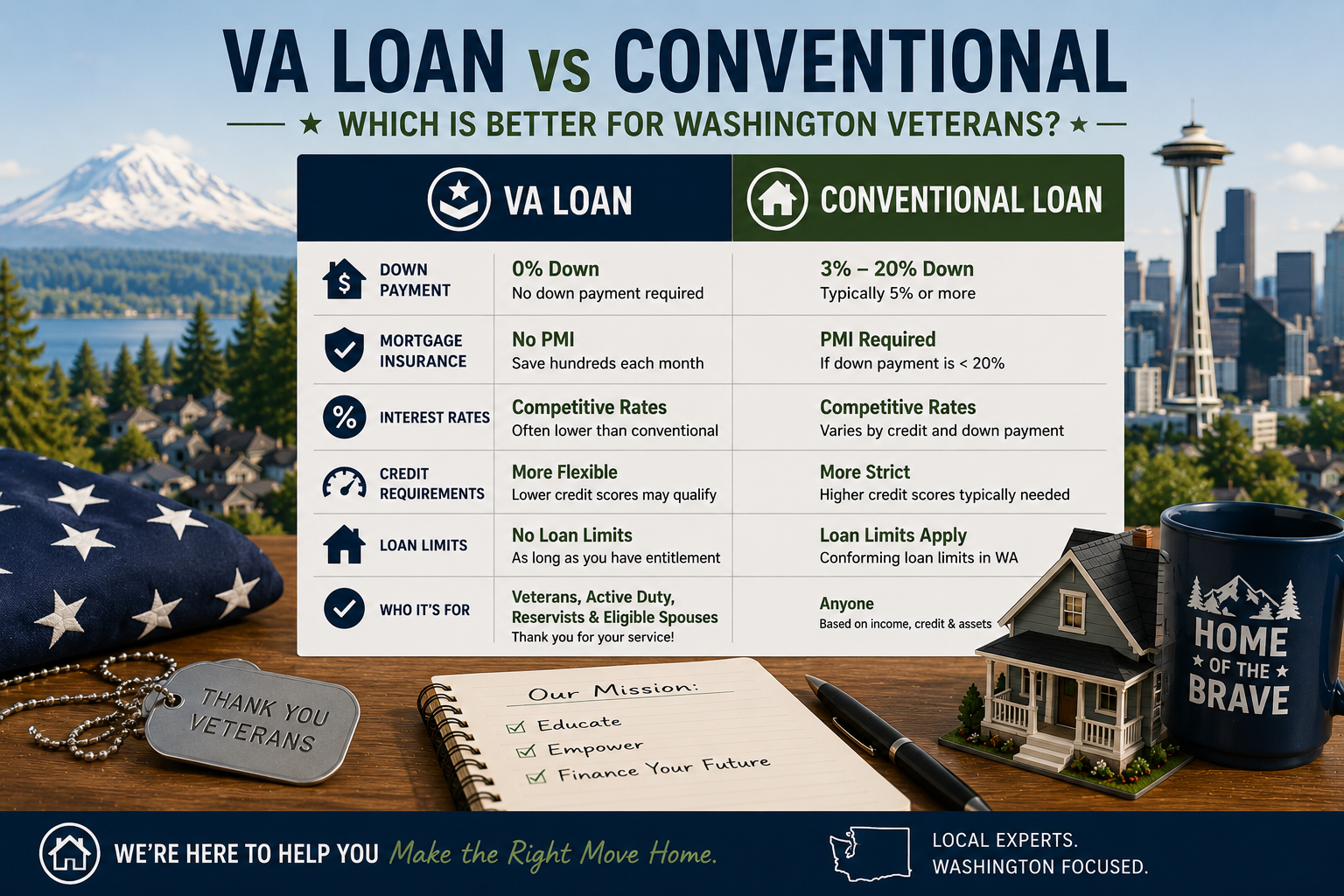
VA loans beat conventional in most scenarios for eligible veterans in Washington. Here's the real cost comparison so you can make the right call for your situation.
VA Loan vs. Conventional: Which Is Better for Washington Veterans?
Most veterans already know they have a VA loan benefit. What fewer know is whether they should use it.
That question comes up more than you would think. Some veterans assume conventional is cleaner or less complicated. Some have heard the VA appraisal is difficult. Some have been told by a seller's agent that VA offers are weaker in competitive markets. Some just want to know the numbers before they decide.
This post gives you the numbers. It also gives you the honest answer about when the VA loan wins, when conventional is worth considering, and what to watch for in Washington's specific market.
The Core Comparison: What Each Loan Costs
The VA loan and a conventional loan are not equivalent products with different names. They have structurally different cost profiles, and for most veterans buying a primary residence in Washington with less than 20% down, the VA loan wins the math comparison by a significant margin.
Here is why.
Down payment. A VA loan requires zero down for eligible borrowers with full entitlement. A conventional loan at its most accessible requires 3% down for first-time buyers, and more typically 5% for repeat buyers. On a $600,000 home in Washington, that is $18,000 to $30,000 you either keep in your pocket or have to save before you can buy.
Mortgage insurance. Conventional loans with less than 20% down require private mortgage insurance, or PMI. PMI can add $100 to $300 per month on a conventional loan under 20% down. VA loans have no monthly mortgage insurance at any down payment amount. That savings compounds every month for as long as you hold the loan.
Interest rate. VA rates typically run 0.25% to 0.50% below conventional at the same credit tier. On a $550,000 loan, a half-point rate difference is roughly $170 per month. Over 30 years, that is more than $60,000.
Loan-level price adjustments. VA does not use loan-level price adjustments, known as LLPAs, while conventional loans add surcharges based on credit score, down payment size, and other risk factors. LLPAs are fees baked into your conventional rate that increase your cost based on your financial profile. The VA program does not have them. A veteran with a 680 credit score gets a VA rate. A conventional borrower at 680 pays a higher rate and higher fees than a borrower at 740.
The One Cost the VA Loan Does Have: The Funding Fee
The VA loan is not free. Most borrowers pay a one-time VA funding fee at closing.
The funding fee is 2.15% for first-time use with zero down. On a joint VA loan with two veterans, the fee calculation splits based on each borrower's history. On a $500,000 loan, that is $10,750. It can be rolled into the loan so you do not need to bring it as cash, but it does increase your loan balance.
The funding fee is where conventional can occasionally make more sense in very specific scenarios. If you have a large down payment available, say 20% or more, a conventional loan eliminates PMI entirely, the rate gap narrows, and the absence of a funding fee starts to look more attractive. In that scenario, running both calculations with your loan officer is worth doing before you decide.
But there is a significant exception that changes everything for a large share of veterans: funding fee exemption applies to veterans with any service-connected disability rating, including 0%, Purple Heart recipients on active duty, and surviving spouses. If you qualify, verify your exempt status before running comparisons. It changes the entire math.
If the VA borrower is funding fee exempt, the VA loan costs zero in both upfront and monthly mortgage insurance, and the comparison is not close. A funding-fee-exempt veteran using a VA loan has no down payment requirement, no PMI, no funding fee, and a lower interest rate than a conventional borrower at the same credit profile. That combination does not exist in any other residential mortgage program.
Running the Real Numbers in Washington
Abstract comparisons are useful. A concrete example is better.
On a $400,000 loan at current rates, a VA monthly principal and interest payment with no PMI compares favorably to a conventional loan at a slightly higher rate with 3% down plus approximately $200 per month in PMI. Over five years, that monthly PMI difference alone adds up to $12,000. Add the rate differential and the zero down payment advantage, and the total cost gap between the two scenarios for a Washington veteran buying a typical Pierce or Snohomish County home is substantial.
Over a 5-year hold on a $400,000 home, the total savings from zero down, no PMI, and a lower rate typically exceeds $25,000 compared to conventional financing.
In Washington's market, where median home prices in King County hover near $860,000 and Pierce County sits around $485,000, the dollar amounts involved are larger than the national example. The PMI savings are larger. The down payment savings are larger. The rate differential is applied to a larger loan balance. The VA advantage compounds accordingly.
When Conventional Might Make Sense for a Veteran
The VA loan wins most cost comparisons for primary residence purchases. But there are scenarios where conventional is worth considering.
You are buying a second home or investment property. VA loans are for primary residences only. If you are buying a vacation home, a rental property, or any home you do not plan to occupy as your main residence, conventional or a specialty product like a DSCR loan is the path. The VA benefit does not apply.
You have full 20% down and want no funding fee. If you have significant liquid assets and plan to put 20% down on a conventional loan, you eliminate PMI, narrow the rate gap, and avoid the funding fee entirely. At that down payment level, the VA advantage shrinks. Still run both scenarios, but conventional becomes a more competitive option.
You are in a market where VA offers face resistance. In some competitive Washington markets, listing agents have historically steered sellers away from VA offers based on outdated assumptions about appraisal difficulty. This perception has faded but not disappeared entirely. VA loans offer flexible credit requirements and competitive rates, making them an exceptional choice for most veterans, but in a specific multiple-offer situation where a seller has shown resistance to VA financing, a conventional offer can sometimes remove a barrier. This is a tactical consideration, not a cost one. Talk to your real estate agent about the specific property and seller before making this call.
Your loan amount is above the conforming limit and you have reduced entitlement. Veterans with full entitlement have no VA loan limit. But veterans who have used their VA benefit before and not fully restored it may have reduced entitlement, which affects how much they can borrow without a down payment. Above the 2026 conforming limit, VA jumbo loans keep the zero-down benefit for veterans with full entitlement, while conventional jumbo loans typically require 10 to 20% down with stricter reserve requirements. Verify your entitlement status with your loan officer before assuming your limit.
The Myth About VA Appraisals
This deserves its own paragraph because it affects how veterans think about their options.
The VA appraisal has a reputation for being difficult, slow, or deal-killing. That reputation is partially earned from a different era and largely outdated. VA appraisals do enforce minimum property standards, meaning the home must be safe, structurally sound, and sanitary. A home with significant deferred maintenance or code violations may have appraisal conditions.
But the same is true of FHA appraisals, and to a lesser degree conventional appraisals as well. A home in poor condition is a problem for any buyer, not just VA buyers. A well-maintained home in reasonable condition passes a VA appraisal without drama in the overwhelming majority of transactions.
Working with a loan officer who handles VA loans regularly, and a real estate agent who knows how to write a clean VA offer and select appropriate properties, eliminates most of the friction that gives VA appraisals their reputation.
The Bottom Line
For the vast majority of eligible veterans buying a primary residence in Washington with less than 20% down, the VA loan is the stronger financial product. Zero down, no PMI, lower rates, and no LLPAs add up to a meaningful cost advantage over the life of the loan.
The funding fee is real and should be factored in. If you are funding-fee exempt, the case for using your VA benefit is nearly airtight for a primary residence purchase.
The right answer for your specific situation depends on your entitlement status, your available assets, your credit profile, and the property you are targeting. That comparison takes about 15 minutes to run with the right information in front of you.
Ready to see the VA vs. conventional numbers for your specific situation in Washington?
Schedule a free 15-minute call and we will run both scenarios side by side so you can make the right call before you make an offer.