Ready to Buy Your First Home? Here's How to Know for Sure
By Terry Leinneweber · May 4, 2026
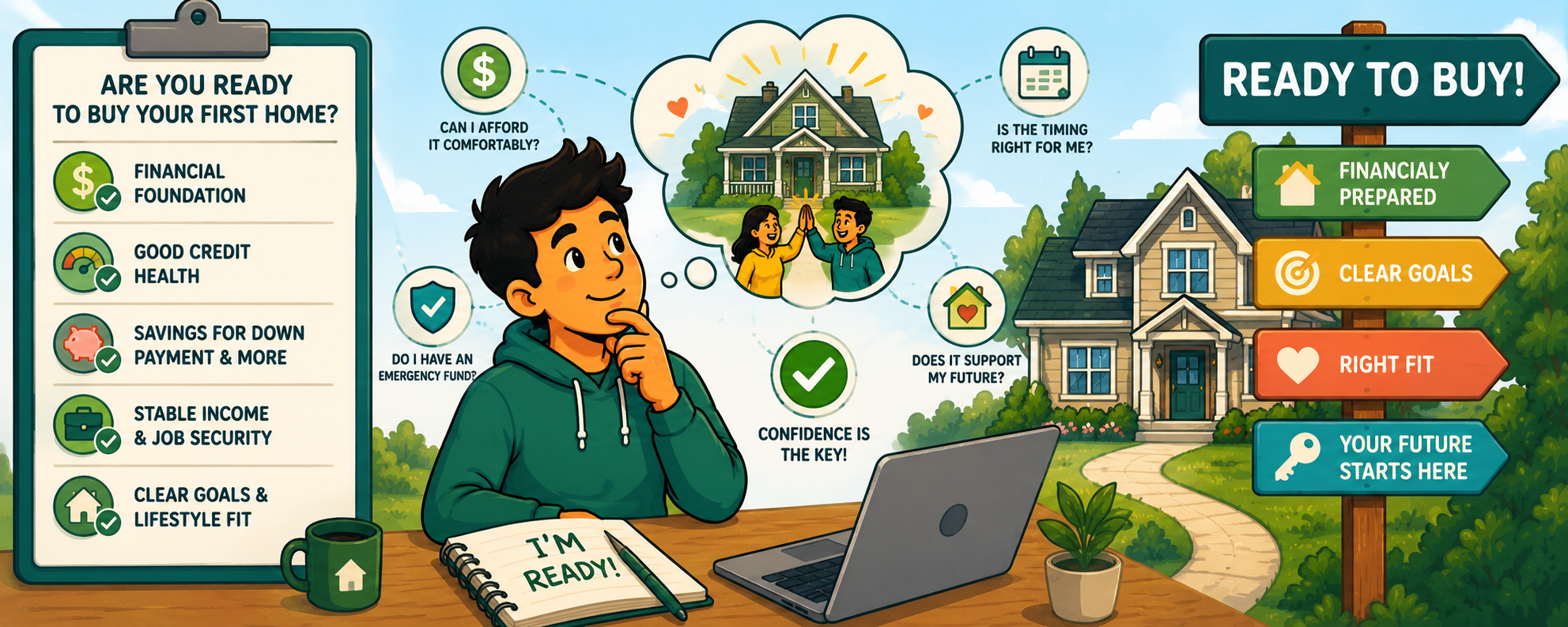
Not sure if you're financially ready? These five checkpoints will tell you exactly where you stand.
Ready to Buy Your First Home? Here's How to Know for Sure
That question deserves a real answer, not a pep talk.
Readiness isn't a feeling. It's a set of financial conditions, and most of them are measurable right now. Here's how to look at each one honestly, so you stop guessing and start moving, or know exactly what to fix before you do.
Your Credit Score: The Number That Opens Doors
Your credit score determines which loan programs you qualify for and what interest rate you'll get. Those two things directly control your monthly payment.
Here's where the thresholds generally fall:
-- 620 or above gets you into most conventional loan programs, the most common loan type for buyers with standard W-2 income and solid credit history.
-- 580 or above qualifies you for an FHA loan, which is a government-backed mortgage that allows as little as 3.5% down. FHA loans are one of the most common paths for first-time buyers precisely because the credit bar is lower.
-- Below 580 doesn't mean you can't buy. It means you likely need 3 to 6 months of focused credit work before applying.
If you don't know your score, check it now through your bank app or a free service like Credit Karma. One number can change your entire timeline.
Takeaway: You don't need perfect credit. You need to know your number and understand which programs it unlocks.
How Much Do You Actually Need Saved?
This is where most buyers get tripped up. They save for a down payment and forget everything else.
Here's what you actually need cash for:
-- Down payment: Ranges from 0% (VA and USDA loans) to 3% to 5% (conventional and FHA) to 20% (if you want to avoid PMI, which stands for private mortgage insurance, a monthly fee added to your payment when you put less than 20% down).
-- Closing costs: Typically 2% to 5% of the loan amount. On a $350,000 home, that's $7,000 to $17,500. Some of this can be negotiated into the deal or covered by seller concessions, but you need to plan for it.
-- Cash reserves: Most lenders want to see 1 to 3 months of mortgage payments sitting in your account after closing. This isn't spent, just verified.
You don't have to have all of this saved if you qualify for down payment assistance (DPA), which is a state or local program that contributes grant or loan funds toward your down payment and closing costs. These programs are more available than most buyers realize.
Takeaway: Add up your down payment target, estimated closing costs, and one month of reserves. That's your real savings goal.
Your Debt-to-Income Ratio: The Number Lenders Care Most About
Your DTI, or debt-to-income ratio, is the percentage of your gross monthly income that goes toward debt payments. Lenders use it to decide how much you can safely borrow.
The math is simple. Add up all your monthly debt payments, including car loans, student loans, credit cards, and the estimated mortgage payment. Divide that by your gross monthly income (before taxes). The result is your DTI.
Most conventional loans want your total DTI at or below 45%. FHA loans can stretch to 50% in some cases with compensating factors like extra savings or a strong credit score.
If your DTI is too high, you have two levers: pay down debt or increase income. Both take time, but knowing your number tells you exactly how much time.
Takeaway: Run your own DTI calculation before you meet with anyone. If it's above 45%, start targeting the debt with the highest monthly payment.
Stable Income: What Qualifying Actually Means
Lenders want to see a two-year history of consistent income. That doesn't mean you need the same job for two years. It means your income type, whether W-2, self-employed, or a combination, needs to be documented and reliable.
If you're self-employed, the income calculation gets more involved. Lenders typically use your two-year average of net income from tax returns. If your write-offs are high and your net is low, you may qualify for less than you expect, or you may be a better fit for a bank statement loan, which qualifies you on actual deposits instead of tax returns.
If you've recently changed jobs but stayed in the same field, that generally doesn't hurt you. A career change from one industry to a completely different one right before applying can raise flags.
Takeaway: Two years of documented income in the same field or industry is the baseline. Gaps or changes aren't automatic disqualifiers, but they need an explanation.
You've Run the True Monthly Cost, Not Just the Mortgage Payment
This is the last check, and it's one buyers skip more than any other.
Your mortgage payment is not your housing cost. Your full monthly number includes principal and interest, property taxes, homeowner's insurance, and HOA fees if applicable. It may also include PMI if you're putting less than 20% down.
On a $350,000 home with 5% down at 5.5-6.5% interest, your principal and interest payment might be in the $1,900 to $2,100 range. Add taxes, insurance, and PMI and the real number is often $400 to $600 higher.
That's not a reason not to buy. It's a reason to know what you're actually signing up for.Takeaway: Ask your lender for a full payment estimate, including taxes and insurance, before you set your price range.
So, Are You Ready?
If your credit is at or above 580, you have your down payment and closing costs covered, your DTI is under 45%, your income is stable and documentable, and you've run the real monthly cost, you're not just thinking about buying. You're ready.
If one or two of those boxes aren't checked yet, that's not failure. That's a list. Most buyers get there within 3 to 6 months of focused preparation, and knowing exactly what needs work is most of the battle.
The fastest way to find out where you stand? Talk to a lender before you're "ready." A 15-minute conversation can tell you more than months of research on your own.
Schedule a free 15-minute call here and find out exactly where you stand today.